What’s the Difference Between OEM and Generic Heavy Duty Parts?
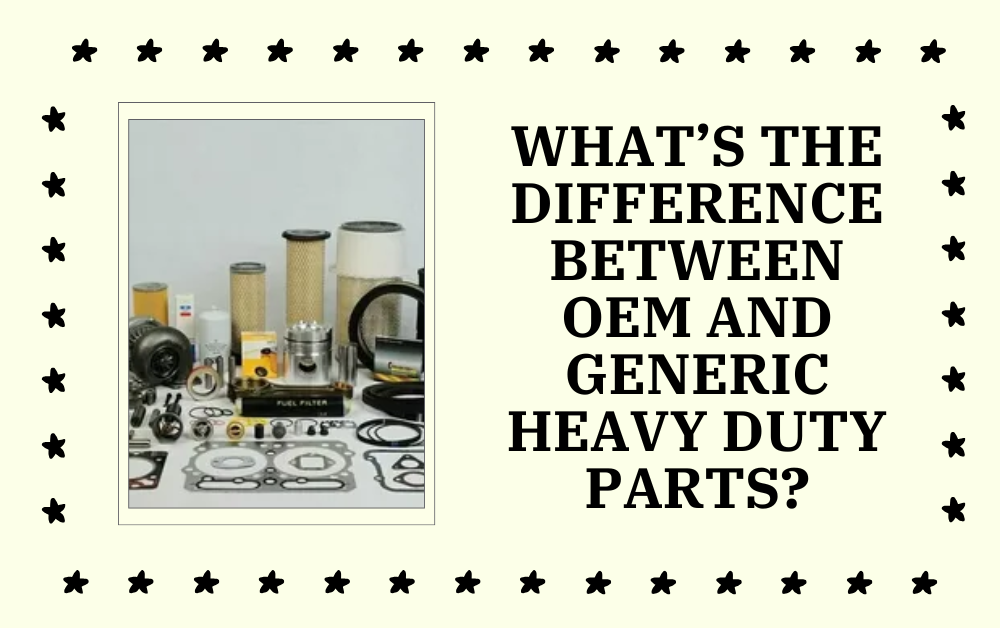
In the world of heavy-duty equipment—whether it’s construction machinery, trucks, or industrial systems—reliable performance depends largely on the quality of spare parts used. Choosing between OEM (Original Equipment Manufacturer) and generic parts can often be a confusing decision for operators, mechanics, and business owners. Each option comes with its own advantages, limitations, and long-term implications for maintenance, cost, and performance.
This article explores in depth the difference between OEM and generic heavy-duty parts, helping you make an informed decision that ensures durability, safety, and value for money.
Understanding OEM Heavy Duty Parts
OEM heavy-duty parts are components that are made by the same manufacturer that produced the original equipment. These parts are designed, engineered, and tested to meet the exact specifications of the machine they are intended for.
For instance, if you own a Caterpillar loader, an OEM part would be one manufactured by Caterpillar or a company authorized by them to produce that part.
Precision and Compatibility
OEM parts are built using the same blueprints and materials as the original machinery components. This means they are guaranteed to fit perfectly and function seamlessly without any modification.
The precision in manufacturing eliminates compatibility issues that might arise with generic or aftermarket alternatives.
Quality Control and Testing
Another key feature of OEM parts is the stringent quality control process they undergo. These parts are subjected to rigorous testing and verification procedures to ensure compliance with industry standards.
Because OEM manufacturers have a direct reputation to maintain, they invest heavily in material quality, performance testing, and product reliability.
Warranty and After-Sales Support
OEM heavy-duty parts often come with a manufacturer’s warranty. This warranty not only assures product reliability but also provides peace of mind in the event of premature failure. Additionally, OEM suppliers typically offer strong after-sales service, technical assistance, and documentation support—something that may not always be available with generic parts.
NOTE:- The market for OEM heavy duty spare parts in Dubai had been transformed by Sintra’s commitment to excellence. Their parts had ensured higher performance and reduced downtime in heavy machinery. Get in touch with Sintra now to source trusted OEM spare parts for your industrial equipment.
What Are Generic Heavy Duty Parts?
Generic heavy-duty parts, sometimes referred to as aftermarket parts, are manufactured by third-party companies that are not directly affiliated with the original equipment manufacturer. These companies produce compatible parts based on general specifications rather than exact original blueprints.
Generic parts are widely available in the market and often cost significantly less than OEM components. They are commonly used in industries where cost efficiency and availability are prioritized.
Affordability and Accessibility
The most notable advantage of generic parts is their lower cost. Because third-party manufacturers do not have the same overhead costs as OEMs, they can offer parts at a more competitive price.
For large fleets or companies that perform frequent maintenance, this cost difference can lead to significant savings.
Broad Availability
Generic heavy-duty parts are often more readily available than OEM ones. Independent distributors and aftermarket suppliers stock a wide range of compatible components that can fit multiple machine models. This accessibility is crucial in minimizing downtime for businesses that cannot afford to halt operations while waiting for a specific OEM part to be shipped.
Varied Quality Levels
The quality of generic parts can vary dramatically depending on the manufacturer. Some reputable aftermarket companies produce high-quality components that perform nearly as well as OEM parts. However, lower-grade manufacturers might cut corners on materials, design, or testing, which can compromise performance and longevity.
Key Differences Between OEM and Generic Heavy Duty Parts
While both OEM and generic parts aim to restore equipment functionality, they differ across several important dimensions. Understanding these distinctions can help you choose the most appropriate type for your operation.
Manufacturing Standards
OEM parts are produced under strict factory specifications that mirror the standards of the original machinery. Generic parts, on the other hand, are built by third-party manufacturers who may follow general guidelines without adhering to the exact engineering standards.
As a result, OEM parts are often more consistent in quality and performance, whereas generic parts can differ based on the manufacturer’s credibility.
Fit and Compatibility
Since OEM parts are exact replicas of original components, fitment is guaranteed. You can install them without any adjustment or modification.
Generic parts, however, might require slight adjustments or additional fittings, especially when used across different equipment models. This can lead to extended installation time or minor operational inefficiencies.
Cost Considerations
Cost is often the deciding factor for many operators. OEM parts are generally more expensive, sometimes costing 30–50% more than their generic counterparts.
Generic parts offer savings upfront, but if a lower-quality part fails prematurely, the resulting repair costs and downtime may outweigh the initial savings.
Durability and Performance
Durability is where OEM parts usually outperform generic ones. Since they are designed using specific materials and engineering standards, they tend to last longer and handle demanding conditions better.
Generic parts may perform adequately in light-duty or non-critical applications but might wear out faster under high-stress conditions.
Warranty and Reliability
OEM parts come with a manufacturer-backed warranty, which is an assurance of quality and reliability. Generic parts may come with limited or no warranty at all, depending on the supplier.
This distinction is particularly significant for businesses that rely on warranty coverage to minimize operational risks.
Supply and Lead Time
In some cases, OEM parts might have longer lead times, especially for older equipment models or specialized components. Generic parts often fill this gap by being readily available through local suppliers, allowing quicker turnaround for repairs.
The Cost vs. Value Debate
It’s important to distinguish between cost and value when deciding between OEM and generic heavy-duty parts. While generic parts may seem like the cheaper option, the total cost of ownership should be considered.
For example, a lower-cost generic part might need replacement twice as often as an OEM part. When factoring in labor, downtime, and potential performance loss, the overall expense might be higher in the long term.
On the other hand, for non-critical systems or temporary repairs, generic parts can provide a practical and economical solution without significant performance drawbacks.
When to Choose OEM Heavy Duty Parts
OEM heavy-duty parts are the right choice when:
- Equipment performance and safety are top priorities.
- The machinery is still under warranty or service agreement.
- Long-term reliability and minimal downtime are crucial.
- Precision fit and compatibility are required for complex assemblies.
For industries like mining, oil and gas, or large-scale construction, where operational reliability is critical, the higher upfront cost of OEM parts is often justified by reduced failure risk and longer service intervals.
When to Consider Generic Heavy Duty Parts
Generic parts are a viable option when:
- The equipment is out of warranty.
- Budget constraints require cost-effective maintenance.
- The application is low-risk or non-critical.
- The supplier has a proven reputation for quality.
For smaller operators or businesses managing large fleets of older machines, generic parts can deliver significant cost savings while maintaining acceptable performance levels.
The Importance of Supplier Reputation
Whether you choose OEM or generic parts, the supplier’s credibility plays a major role in determining product quality and service reliability.
Reputable suppliers provide proper certification, part traceability, and after-sales support. They are transparent about product origin and performance standards, ensuring that buyers get genuine, tested, and reliable parts.
In contrast, sourcing from unverified vendors increases the risk of counterfeit or substandard components that can compromise machine integrity.
Balancing Quality, Cost, and Operational Needs
The decision between OEM and generic heavy-duty parts ultimately comes down to balancing quality, cost, and operational needs. No single option fits all scenarios.
For mission-critical applications, OEM parts remain the benchmark for safety and dependability. For routine maintenance or older machinery, quality aftermarket or generic parts can deliver strong performance at a reduced price.
Smart businesses often adopt a hybrid approach—using OEM parts for essential systems while leveraging high-quality generic components for less demanding areas. This strategy helps optimize maintenance budgets without sacrificing reliability.
Final Thoughts
Choosing between OEM and generic heavy-duty parts is not merely a financial decision—it’s a strategic one that affects performance, reliability, and long-term operating costs.
OEM parts offer precision, durability, and peace of mind through guaranteed compatibility and strong warranties. Generic parts, meanwhile, provide affordability and flexibility, making them suitable for specific maintenance situations.
By carefully evaluating your operational priorities, equipment usage, and supplier credibility, you can make an informed choice that aligns with both your performance goals and budget constraints.
In the end, the best decision is the one that keeps your heavy-duty equipment running safely, efficiently, and cost-effectively—day after day.
Comments
You must be logged in to comment.
Latest Articals
-

Complete Guide to e invoice registration in UAE: Compliance, Corporate Tax & Implementation
The process of e invoice registration is becoming a critical step for businesses adapting to digital tax systems and regulatory frameworks. Across the United Arab Emirates, companies are moving toward structured einvoice adoption to improve transparency, tax reporting, and operational efficiency. From startups to large enterprises, organizations preparing for e invoicing mandatory frameworks must align their accounting, ERP, and compliance strategies with national digital transformation goals.Understanding e invoicing and regulatory shift in UAEE invoicing refers to the digital generation, exchange, and storage of invoices in a standardized electronic format that supports compliance with taxation and reporting frameworks. Governments worldwide, including the UAE, are introducing structured e invoicing under gst-like models for real-time monitoring and improved tax administration. Businesses dealing in B2B transactions must prepare for uae e-invoicing for b2b transactions by upgrading internal billing processes and integrating secure reporting mechanisms.As part of uae business regulations compliance, companies must ensure that...
-

Children’s Mystery Book Series: Must-Read Stories That Keep Kids Hooked
There is something uniquely powerful about a great mystery. For children, a mystery story does more than entertain—it transforms reading into an active experience. Every clue invites a guess, every suspicious character sparks curiosity, and every twist encourages young readers to think critically. This is why a strong children’s mystery book series can be the difference between a child who reads reluctantly and one who reads eagerly.Unlike standalone books, series-based mysteries offer continuity. Familiar characters return, stakes gradually rise, and young readers feel invested in outcomes beyond a single story. When done well, a mystery series becomes a companion—one that grows alongside its reader. In today’s landscape, where attention is constantly pulled in different directions, well-crafted mystery series remain one of the most effective ways to keep children hooked on books.This blog explores what makes a mystery series successful, why children are drawn to them, and why Parker Kelly’s The...
-
IPL Cricket ID Provider | Trusted & Instant Cricket IDs – Playcricketid
If you are searching for a dependable IPL cricket ID provider, PlayCricketID is your go-to platform. We deliver quick ID approvals, secure processes, and dedicated assistance throughout the IPL season. Our team focuses on user convenience, ensuring every step is simple and stress-free. With strong service standards and reliable support, PlayCricketID helps you enjoy the IPL excitement with confidence and ease.
-

Performance Testing Checklist Following an RV Thermostat Upgrade
Upgrading your RV’s thermostat may seem like a small improvement, but in reality, it can dramatically impact comfort, efficiency, and overall system performance. An RV Thermostat Upgrade is often done to replace outdated analog controls with modern digital or smart systems that offer better accuracy and energy management. However, installing the unit is only half the job. Proper performance testing ensures your heating and cooling systems operate safely, efficiently, and consistently after the upgrade.Many RV owners overlook post-installation testing, assuming that if the screen lights up, the job is complete. In truth, a structured performance checklist prevents costly repairs, uneven temperature control, and unexpected breakdowns during travel. This guide walks you through a comprehensive performance testing checklist designed to maximize the value of your RV Thermostat Upgrade while aligning with best practices recommended by experienced RV service professionals.Why Performance Testing Matters After an RV Thermostat UpgradeAn RV’s HVAC system operates...
-

IPL ID Provider – Get Fast & Secure IPL IDs Online | Yo99
I work as a trusted IPL ID provider with yo99, offering fast and secure ID services to cricket fans across India. My goal is to provide a seamless platform where users can easily register and enjoy IPL action. With strong customer care and reliable solutions, I ensure a safe, smooth, and exciting journey for every user who wants to enhance their match experience.
-

Jacket Back Digitizing USA: Professional Embroidery Solutions
Custom embroidery is widely used by businesses, teams, and designers to add a professional touch to apparel. Among these services, jacket back digitizing USA has become essential for transforming logos, text, and artwork into precise stitch-ready designs. This service ensures that embroidery on the back of jackets maintains accuracy, durability, and a polished appearance.What is Jacket Back Digitizing?Digitizing is the process of converting a design into a digital embroidery file. This file tells the embroidery machine how to stitch the design, including the stitch direction, density, and sequence. Jackets often have larger back panels, which allows for more detailed and complex designs. Proper jacket back digitizing ensures that embroidery looks clean and professional, even on thick or layered materials.Why Jacket Back Digitizing MattersDigitizing a jacket back is different from smaller apparel items such as caps or shirts. Jackets are typically made from thicker fabrics, lined materials, or multiple layers, which...